
Can Menopause Cause Joint Pain All Over the Body?
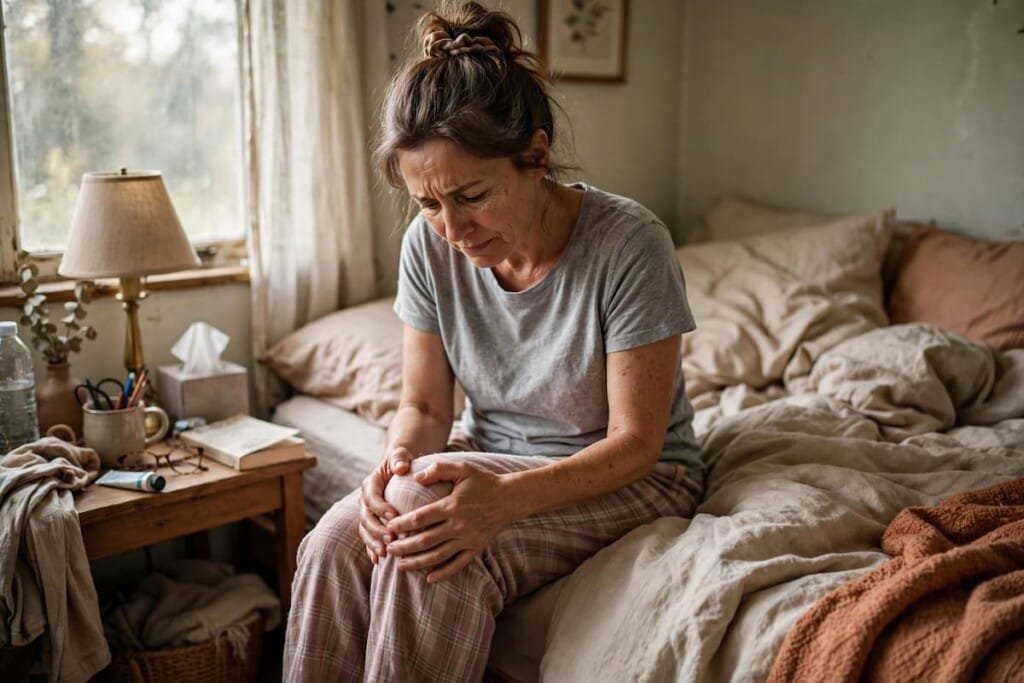
You used to get out of bed without thinking about it. Now you sit on the edge of the mattress for a minute, waiting for your body to negotiate the day. Your shoulders ache. Your knees complain on the stairs. Your fingers feel stiff around your coffee mug, and your hips protest when you stand up after sitting too long.
So you ask the obvious question: can menopause cause joint pain all over the body — or is this something else entirely? Here’s what most women are never told: in 2024, researchers finally gave this exact pattern a name. And having a name for it changes everything about how seriously it’s taken.
The short answer
Yes — declining estrogen during perimenopause and menopause is linked to widespread joint and muscle aches, and it’s common enough that researchers now treat it as its own recognized pattern. In a 2024 review published in Climacteric (the journal of the International Menopause Society), researchers introduced the term “musculoskeletal syndrome of menopause” to describe the collective of musculoskeletal symptoms tied to estrogen loss — including joint pain, loss of muscle mass, loss of bone density, and faster progression of osteoarthritis. The review’s authors estimate that more than 70% of women experience musculoskeletal symptoms through the menopause transition.
That doesn’t mean every ache at 50 is hormonal — and this article won’t diagnose you (I’m not a medical professional, and nothing here replaces your doctor). But it does mean your all-over achiness has a real, studied explanation. Let’s walk through it.
Can menopause cause joint pain? The estrogen–joint link
Estrogen isn’t just a reproductive hormone — it’s active throughout your musculoskeletal system. The authors of the 2024 review describe estrogen receptors in joint tissues, cartilage, tendons, ligaments, and muscle. In the researchers’ account, estrogen helps regulate inflammation, maintain cartilage health, preserve muscle mass and strength, protect bone density, and support tendon remodeling.
During perimenopause, estrogen doesn’t decline smoothly — it fluctuates wildly before eventually falling. That hormonal chaos, followed by sustained low estrogen after menopause, gradually removes the protection your joints, tendons, and muscles relied on for decades. The result researchers describe: more aching and stiffness, more irritated tendons, weaker muscles, thinner bones, and joints that feel like they aged a decade in two years.
This is why the pain can feel so diffuse. It’s not one injured joint — it’s a system-wide change in how your connective tissues behave.
The musculoskeletal syndrome of menopause: what’s under the umbrella
The term was coined in October 2024 by the authors of the Climacteric review — including Dr. Vonda Wright, an orthopedic sports surgeon at the University of Central Florida School of Medicine. Harvard Health has since covered it, quoting Dr. Deborah Gomez Kwolek, a menopause expert at Harvard-affiliated Mass General Brigham, on why naming the pattern matters: when a problem has a name, it gets studied, discussed, and taken seriously instead of dismissed as “just aging.”
Under this umbrella, researchers group:
- Arthralgia — achy joints without visible swelling, often in the knees, hips, shoulders, and hands
- Morning stiffness — that shuffling, creaky first hour of the day
- Tendon and ligament irritation — including frozen shoulder (adhesive capsulitis), which case reports have described as one manifestation of the syndrome
- Loss of muscle mass and strength — making joints work harder with less support
- Loss of bone density — raising fracture risk over time
- Progression of osteoarthritis — existing wear-and-tear can accelerate
Notice what this list does: it connects symptoms women usually experience as separate mysteries — the achy hands, the bum shoulder, the creaky knees — into one coherent, hormonally driven picture.
What it typically feels like
Menopause-related aches have a recognizable pattern. Not everyone gets all of these, but clinicians describe a familiar cluster:
- Morning is the worst. Stiffness and aching that eases as you move around — very different from pain that stays put all day.
- It moves around. Shoulders one week, knees the next, fingers and hips joining in. Migratory, diffuse aching is classic.
- Inactivity makes it worse. Sitting through a movie or sleeping through the night stiffens everything up; gentle movement loosens it.
- Frozen shoulder can appear out of nowhere. A deep ache with loss of range — trouble reaching overhead or behind your back — is notably reported in perimenopausal women. Don’t try to push through a frozen shoulder on your own; it deserves professional evaluation.
- Hands feel clumsy at first. Achy finger joints and weaker grip in the morning, improving as the day goes on.
If this sounds like your body, you’re describing something researchers now recognize — not something you’re imagining.
Menopause aches vs. signs pointing elsewhere
This is the section that matters most, because not all joint pain in midlife is menopause. Some of it needs prompt medical attention, and telling the difference isn’t a DIY project — but knowing the patterns helps you have a smarter conversation with your doctor.
| Pattern | More typical of menopause-related aches | Get evaluated promptly |
|---|---|---|
| Swelling | Achy but not visibly swollen | Joints that are swollen, warm, or red |
| Symmetry | Aches wander between joints | Swelling in matching joints on both sides (both wrists, both hands) — a classic rheumatoid arthritis pattern per NIAMS |
| Morning stiffness | Eases within minutes of moving | Lasts well over 30 minutes and won’t loosen up |
| Whole-body signs | No fever, no rash | Fever, rash, or profound fatigue alongside joint pain |
| Onset | Gradual, over months, in your 40s–50s | Sudden severe pain in one joint, or pain after an injury |
| Function | Stiff but usable | Can’t bear weight, joint locks, or gives way |
Don’t self-diagnose from this table. Rheumatoid arthritis and other inflammatory conditions can cause permanent joint damage when treatment is delayed — and early treatment makes a real difference. If anything in the right-hand column sounds like you, book an appointment rather than waiting to see if it passes. “It’s probably just menopause” is exactly the assumption that delays real diagnoses.
What actually helps
There’s no single fix, but the same strategies come up again and again in clinical guidance — and none of them require a prescription to start:
Keep moving — especially resistance training. Federal activity guidelines recommend at least 150 minutes of moderate aerobic activity per week plus muscle-strengthening on two or more days. For achy joints, low-impact options (walking, swimming, cycling) keep you mobile without pounding, while resistance training protects the muscle and bone that estrogen decline threatens. Stronger muscles literally unload your joints.
Build a morning mobility routine. Since mornings are the worst, a short routine that targets that window pays off disproportionately. If getting out of bed has become a production, this is worth a look: Morning Joint Stiffness After 50: A Simple Mobility Routine.
Use heat for stiffness, cold for flare-ups. Warmth (a shower, heating pad) loosens stiff joints in the morning; cold can calm an irritated tendon after activity. Simple, unglamorous, effective.
Protect your sleep. Poor sleep lowers pain tolerance — aching joints genuinely hurt more after a bad night. Whatever helps you sleep better helps your joints feel better too.
Keep weight in a healthy range. Every extra pound multiplies the load on knees and hips. You don’t need dramatic weight loss for your joints to notice a difference.
Talk to your doctor about the full picture. Whether menopause hormone therapy or other treatments are appropriate for you is a personal medical decision — one to make with a clinician who knows your history, not from an article. Bring your symptom notes (below) so the conversation starts from evidence, not vibes.
What to track before your appointment
Two weeks of notes can turn a vague “I ache everywhere” into something your doctor can actually work with:
- Which joints, and when: shoulders in the morning? Knees after stairs? Fingers at night?
- Stiffness duration: how many minutes until you loosen up?
- Swelling, warmth, or redness: yes or no — this is the single most useful detail
- What helps, what worsens: movement? Rest? Heat? A particular activity?
- Sleep and activity: rough hours of sleep, rough daily movement
“I wake up stiff for about 20 minutes, no swelling, and it eases once I’m moving” gives a clinician far more to work with than “my joints hurt.”
FAQs
Can menopause cause joint pain even if I’ve never had arthritis?
Yes. Menopause-related joint pain (arthralgia) is about hormonal changes affecting connective tissue — it doesn’t require pre-existing arthritis. Many women with no joint history at all develop widespread aches during perimenopause.
Why is it always worse in the morning?
Overnight inactivity lets stiffness set in, and inflammatory processes follow a daily rhythm that peaks in the early hours. Gentle movement usually eases it — which is itself a useful clue, since inflammatory arthritis stiffness tends to linger much longer.
Can menopause cause frozen shoulder?
Frozen shoulder (adhesive capsulitis) has been described in medical case reports as one manifestation of the musculoskeletal syndrome of menopause, and clinicians report seeing it disproportionately in perimenopausal women. If your shoulder is freezing up, get it evaluated rather than stretching aggressively through it.
How do I know it’s not rheumatoid arthritis?
Honestly? You can’t know on your own — and that’s the point. Per NIAMS, RA warning signs include joint swelling with warmth and tenderness, morning stiffness lasting longer than 30 minutes, symmetric involvement (both hands, both wrists), fatigue, and occasional low-grade fever. If those fit, see a doctor promptly. Only clinical evaluation and testing can distinguish the two.
Will the aches go away after menopause?
It varies. Some women find the diffuse aching settles as hormones stabilize; for others, the bone-density and osteoarthritis components need ongoing management. There’s no guaranteed timeline, which is why building strength and getting evaluated early matters more than waiting it out.
Where to go from here
If mornings are your hardest part, start there — the morning joint stiffness routine is built exactly for that window.
And if you’re still asking “can menopause cause joint pain all over the body, or is mine something else?” — that’s precisely the right question to bring to your doctor, with two weeks of notes in hand. The 2024 research gave this pattern a name so it would stop being dismissed. Use that. You deserve an answer based on examination, not assumption.
Sources: Harvard Health, Musculoskeletal syndrome of menopause: When menopause makes you ache all over (term coined October 2024; Dr. Deborah Gomez Kwolek, Mass General Brigham); Wright et al. 2024, The musculoskeletal syndrome of menopause, Climacteric (review introducing the term; estrogen receptors in musculoskeletal tissues; arthralgia, muscle loss, bone density loss, osteoarthritis progression) — PubMed PMID 39077777; Healthline, Musculoskeletal Syndrome of Menopause: Symptoms, Causes, Treatment (umbrella conditions: arthralgia, tendon/ligament injuries, osteoarthritis, osteopenia, osteoporosis); Mayo Clinic Press, What’s happening to my body? Navigating the different stages of menopause (Dr. Denise Millstine: joint pain among menopause symptoms); NIAMS (NIH), Rheumatoid Arthritis — Symptoms, Causes, & Risk Factors (stiffness >30 min, symmetric pattern in wrists/hands/feet, swelling/warmth, fatigue, low-grade fever).
This article is for information only and isn’t medical advice. I’m not a medical professional — if you’re dealing with persistent, worsening, or worrying joint pain, please talk to your doctor.
Keep reading
More evidence-based guides for staying strong after 40.